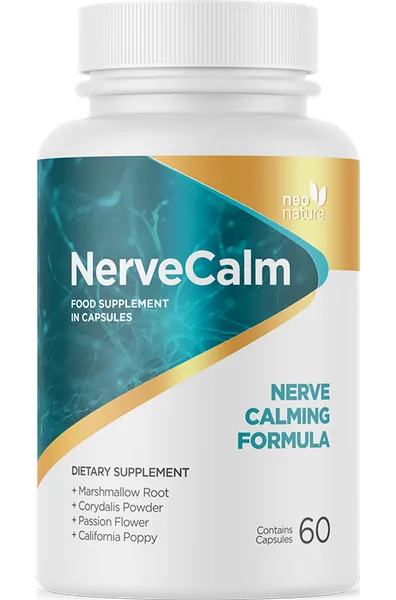
NerveCalm Review 2027
Nerve health capsules built around four disclosed blends — toxin elimination, nerve repair, nerve support, and fast-acting relief. Clear dosing and a 90-day guarantee.
Our Verdict: 4.2/5 — Recommended. NerveCalm is one of the more transparent nerve formulas we've reviewed: four blends with disclosed milligram amounts, a short named-ingredient list, simple dosing, and a real 90-day guarantee. The vendor page leans hard on marketing hype, which costs it points — but the formula itself is straightforward and honestly presented.
On this page
What Is NerveCalm?How Is It Supposed to Work?IngredientsWho Should / Should Not Take ItHow to Use for Best ResultsNerveCalm vs Other OptionsPros & ConsSide Effects & SafetyPricingFAQWhat Is NerveCalm?
NerveCalm is a nerve health supplement in capsule form. According to the vendor, it is designed for people struggling with nerve pain, neuropathy-related discomfort, sciatic pain, and reduced mobility — supporting nerve health rather than just masking pain.
The suggested dose is two capsules daily with a meal and a glass of water, ideally first thing in the morning. Each bottle is a 30-day supply. The product is sold through the vendor's own website, and the offer listing covers the US, Canada, and UK.
Nerve discomfort is one of the most frustrating kinds of daily pain. It can show up as tingling, burning, pins-and-needles, numbness, or sharp shooting sensations, often in the feet, legs, hands, or lower back. Unlike a sore muscle that rests and recovers in a few days, nerve-related discomfort tends to linger, flare unpredictably, and interfere with sleep, walking, and everyday tasks. That is the problem NerveCalm is positioned against: not a one-off painkiller, but a daily capsule intended to support the nerves themselves over time.
It helps to be clear about what this category of product can and cannot do. A dietary supplement is not a prescription medicine, and it is not a treatment for neuropathy, sciatica, or any diagnosed nerve condition. No capsule can repair a compressed nerve, reverse nerve damage, or replace medical care. What a nerve-support formula can plausibly do is supply herbal ingredients traditionally associated with calming irritation, supporting healthy circulation to nerve tissue, and easing the day-to-day discomfort that comes with irritated nerves — while the person using it also follows their doctor's advice, stays active within their limits, and addresses the underlying cause of their symptoms.
That distinction is the lens we use for this review. We judge NerveCalm on three things: whether its ingredients make sense for nerve support, whether its transparency lets a buyer check that for themselves, and whether its pricing and guarantee are fair. On transparency, it scores better than most nerve supplements we have reviewed, because it discloses the milligram total of each of its four blends instead of hiding everything behind a single proprietary blend. On evidence, it is a mixed picture, and we say so plainly in the ingredient sections below: the herbs in this formula have traditional use and some preliminary research, but none of them has the kind of large, conclusive human trials that would let anyone promise a specific result. If you want a fuller framework for judging any supplement label before you buy, read our guide on what to look for in a supplement.
One more point on scope: nerve discomfort has many possible causes — blood-sugar problems, vitamin deficiencies, injury, compression, infections, autoimmune conditions, and medications among them. A supplement does not diagnose or address any of those causes. If your symptoms are new, worsening, spreading, or accompanied by weakness, loss of balance, bladder changes, or wounds that will not heal, see a doctor promptly rather than starting a supplement and waiting. That advice applies to every product in this category, including this one.
How Is NerveCalm Supposed to Work?
The formula is organized into four blends, each with a stated job, per the vendor's description:
- Nerve Toxin Elimination Blend (900mg) — positioned as clearing the buildup the vendor links to nerve discomfort.
- Nerve Repair Blend and Support Pain Relief (1000mg) — the largest blend, aimed at supporting the nerve repair process and easing discomfort.
- Nerve Support Blend (500mg) — ongoing support for nerve function.
- Fast-Acting Formula (600mg) — positioned for quicker perceived relief.
Our honest take: the blend structure is unusually clear for this category — most nerve supplements hide everything behind one proprietary blend with no amounts. That said, individual ingredient doses inside each blend are not disclosed, so we can't verify how much of each herb you're actually getting. The ingredient logic (anti-inflammatory and nerve-support herbs) is coherent, but evidence for any specific blend is limited. Think of it as a daily support habit, not a prescription-strength solution.
To understand what the formula is trying to do, it helps to know a little about how nerves work. A peripheral nerve is essentially a living wire: a long fibre (the axon) carrying signals, wrapped in a fatty insulating layer called myelin that helps those signals travel quickly and cleanly. When that wire is irritated — by pressure, inflammation, poor circulation, high blood sugar, or injury — the signal can misfire. The brain may then register tingling, burning, numbness, or pain even when nothing is actively injuring the tissue at that moment. That is why nerve discomfort often feels so strange and disproportionate: the problem is in the signalling, not in a cut or bruise you can see.
NerveCalm's ingredient logic maps onto that picture in three ways. First, several of its herbs are traditionally used for their calming and pain-easing properties — the idea being to quiet overactive pain signalling and make day-to-day discomfort more manageable. Corydalis Yanhusuo and California Poppy Seed fall in this group; both have long traditional use for discomfort and restlessness, and both are discussed in more detail in the ingredient deep dive below. Second, the formula includes antioxidant and soothing ingredients, such as prickly pear cactus and marshmallow root, which are positioned as supporting the tissue environment around nerves — reducing the background irritation and oxidative stress that can keep nerves sensitised. Third, the "fast-acting" blend is positioned as the short-term comfort layer, while the larger repair and support blends are framed as the longer-term maintenance layer. That two-speed framing is common in this category, and it is a reasonable way to think about a daily supplement: one part aimed at how you feel today, one part aimed at the conditions your nerves live in over weeks and months.
What the mechanism does not include is equally important. Nothing in this formula is shown to regrow myelin, reconnect a damaged nerve, or reverse neuropathy. The vendor's "toxin elimination" language should be read carefully: the body already has its own detoxification systems in the liver and kidneys, and no capsule "flushes plaque from nerves" in the way a drain cleaner clears a pipe. The honest version of that claim is that antioxidant and anti-inflammatory herbs may help reduce the irritation that contributes to nerve discomfort. That is a much smaller claim, and it is the only version the available evidence supports.
Realistic expectations matter here more than with most supplements, because nerve discomfort fluctuates naturally. People often start a supplement during a bad flare, then credit the supplement when the flare settles on its own. The only fair way to judge a product like NerveCalm is consistent daily use over a meaningful stretch — the vendor's 90-day guarantee window is, in effect, the trial period — while tracking symptoms honestly: sleep quality, walking distance, how often tingling or burning wakes you, and whether you are using fewer other pain measures. If nothing has changed after a fair trial, the guarantee exists for exactly that situation. Our guide on how we test and rate supplements explains how we weigh transparency, evidence, and guarantee terms when we score products like this one.
Finally, a supplement works best as one piece of a broader nerve-health routine, not as a substitute for one. The habits with the strongest general support for nerve health are unglamorous: keeping blood sugar in a healthy range if that is a factor, not smoking, staying physically active as your doctor advises, maintaining a healthy weight, getting enough B vitamins from food or a supplement your doctor approves, and treating any underlying condition that is irritating the nerves. NerveCalm does not replace any of those. At best, it is a daily adjunct — a small, consistent input alongside the bigger inputs that actually move the needle.
What's Inside NerveCalm?
| Ingredient | Traditional / Known Role |
|---|---|
| Corydalis Yanhusuo | Traditional Chinese herb; vendor describes it as helping clear plaque from nerves. |
| Opuntia Phaeacantha | Prickly pear cactus; natural antioxidant the vendor links to reduced nerve pain. |
| Marshmallow Root | Soothing herb the vendor links to initiating the nerve repair process. |
| California Poppy Seed | Traditionally used for calm and discomfort relief; may support restful sleep. |
| Althaea Officinalis | The botanical name for marshmallow root — listed separately on the vendor page; a herb used in Ayurvedic tradition for pain support. |
What we like: every ingredient is named and the blend amounts are disclosed (900mg / 1000mg / 500mg / 600mg). What we'd like to see: per-ingredient doses inside each blend, which are not published.
The table above is the summary. The sections below go ingredient by ingredient: what each one is, what the published research actually says, and — critically — how the dose in NerveCalm compares with the dose used in studies. That last comparison is where this product's transparency stops. Because the per-ingredient doses inside each blend are not disclosed, we cannot confirm that any single ingredient is present at a studied amount. A 1,000mg blend split five ways is a very different product from a 1,000mg blend that is mostly one ingredient. Keep that in mind as you read: the research below describes what each ingredient has shown when studied on its own, at a known dose, not what NerveCalm itself has been shown to do.
Corydalis Yanhusuo
Corydalis Yanhusuo is a flowering plant whose dried tuber has been used in traditional Chinese medicine for centuries for pain, cramping, and restlessness. Its best-known active compounds are a group of alkaloids, including tetrahydropalmatine (THP) and dehydrocorybulbine (DHCB). The modern interest in Corydalis comes largely from animal research on DHCB, which appeared to reduce pain signalling in laboratory studies without the sedation or tolerance profile of opioid painkillers. That finding generated real scientific interest — and it is also the point where careful readers should slow down.
The honest evidence summary is: limited human evidence. The most cited DHCB work is preclinical — animals, not people — and the small human studies of Corydalis extracts that do exist are few, short, and use different preparations and doses. There is no large, well-controlled human trial establishing an effective dose of Corydalis for nerve pain specifically. Traditional use is real and long-standing, but traditional use is not the same as clinical proof. In NerveCalm, the dose of Corydalis is not disclosed, so we cannot compare it with any dose used in research. It sits inside one or more of the four blends, and the blend totals (900mg to 1,000mg) tell us nothing about how much Corydalis is in the capsule. If Corydalis is the ingredient that drew you to this product, that missing number is the single biggest gap in the label.
Opuntia Phaeacantha (Prickly Pear Cactus)
Opuntia Phaeacantha is a species of prickly pear cactus. Its pads and fruit are eaten as food in Mexico and the American Southwest, and they are rich in antioxidant compounds, including betalains and flavonoids, plus fibre and some vitamins and minerals. The vendor links it to reduced nerve pain, presumably through its antioxidant and anti-inflammatory profile: the theory is that reducing oxidative stress around nerve tissue may reduce irritation and help nerves function more normally.
The evidence here is preliminary. Prickly pear has a modest human research base for blood-sugar and cholesterol markers, and there is laboratory evidence for antioxidant and anti-inflammatory activity. But there is very little direct research on prickly pear for nerve pain or neuropathy in humans, and no established standard dose for nerve support. As with Corydalis, the dose inside NerveCalm is not disclosed. One practical note: prickly pear can have a mild blood-sugar-lowering effect in some people, which is why people taking diabetes medication should be especially careful to talk to a doctor before using this product (see the safety section below). As a food-derived ingredient, prickly pear is generally considered low-risk in normal dietary amounts; in concentrated supplement form, the same caution that applies to any herbal extract applies here.
Marshmallow Root
Marshmallow root is the root of Althaea officinalis, a plant used in European herbal tradition for thousands of years — the name has nothing to do with the confection, which was originally made from this plant's sap. Its defining property is mucilage: a gel-forming fibre that coats and soothes mucous membranes. That is why it has traditionally been used for sore throats, coughs, digestive irritation, and skin irritation. The vendor links it to "initiating the nerve repair process," which is a much bigger claim than the traditional use supports.
The evidence summary is: traditional use is strong, direct evidence for nerve repair is essentially absent. There are no meaningful human trials showing that marshmallow root repairs nerves. What it plausibly contributes to this formula is a soothing, demulcent quality — it may help settle digestive irritation from the other herbs and is generally gentle on the stomach. That is a real but modest role, and it should not be read as evidence that the formula rebuilds nerve tissue. The dose in NerveCalm is not disclosed, and there is no established studied dose for nerve support to compare it against.
California Poppy Seed
California poppy (Eschscholzia californica) is a flowering plant native to the western United States, traditionally used by Indigenous peoples and later by herbalists for calm, sleep, and discomfort relief. Its active compounds include several alkaloids that are believed to act on the nervous system in a mildly sedating way — not like a sleeping pill, but in the direction of easing restlessness and helping the body settle. That is why it appears in nerve formulas: poor sleep and nerve discomfort feed each other, and anything that helps a person fall asleep and stay asleep can make daytime symptoms feel more manageable.
The evidence is limited but plausible. There are small human studies and a longer tradition of use supporting a mild calming and sleep-supporting effect, but the trial base is small, doses vary, and there is no strong evidence that California poppy directly treats nerve pain. The most realistic expectation is indirect: better rest, less nighttime restlessness, and therefore less next-day sensitivity. The dose in NerveCalm is not disclosed. One safety point matters more than the benefit: because California poppy can cause drowsiness, it should not be combined casually with alcohol, sleep aids, or sedative medication, and you should not drive if you feel drowsy after taking it.
Althaea Officinalis — A Label Quirk Worth Knowing About
Althaea Officinalis is the botanical (Latin) name for marshmallow root — the same plant listed separately as "Marshmallow Root" in this formula. In other words, the vendor page lists one plant twice: once by its common name and once by its scientific name. We flag this because it matters for how you read the label. The formula does not contain five distinct botanical ingredients; it contains four distinct plants, with marshmallow root appearing under two names. This may be a simple labelling redundancy rather than an attempt to mislead — the vendor page also describes Althaea Officinalis in terms consistent with marshmallow root — but it does mean the ingredient list looks longer than it is. A buyer counting distinct ingredients should count four, not five.
The practical consequence is small but real. If you are allergic to or sensitive to marshmallow root, you should treat both listings as the same ingredient. And if you are comparing NerveCalm with another nerve formula, compare distinct ingredients, not line items — a list padded by a duplicate name is not a deeper formula. We have kept the existing page's note about this because it is accurate and because it is exactly the kind of label detail that separates an honest review from a copy of the vendor's marketing.
Stepping back from the individual ingredients: the formula's logic is coherent — a traditional pain-easing herb, a calming herb, an antioxidant food-plant, and a soothing demulcent — but the evidence for each is preliminary or traditional rather than conclusive, and the missing per-ingredient doses mean the formula cannot be checked against the research. That combination — sensible ingredients, honest blend totals, missing per-ingredient doses — is why NerveCalm lands at 4.2 rather than higher. The blend totals are a genuine transparency win; the per-ingredient doses would have made it a much stronger one.
Who Should / Should Not Take It
NerveCalm is best suited to a fairly specific buyer: an adult dealing with ongoing, mild-to-moderate nerve discomfort who has already talked to a doctor about the cause, who wants a daily herbal adjunct alongside medical care, and who understands that the realistic goal is support and comfort — not a cure. If that describes you, and your doctor has no objection, a formula like this one is a reasonable thing to try for a defined trial period, using the 90-day guarantee as the decision window.
It may be a particularly reasonable fit if you prefer plant-based formulas over single-compound supplements, if you value label transparency (the disclosed blend totals are genuinely unusual in this category), and if sleep disruption is part of your symptom picture — the California poppy component is the ingredient most likely to help with the restlessness side of nerve discomfort. It is also a reasonable fit if you want one capsule product rather than assembling your own stack of individual herbs, each with its own dose to research and its own bottle to buy.
It is not the right product for several groups. Do not use NerveCalm as a substitute for medical care if you have a diagnosed nerve condition, worsening symptoms, weakness, loss of balance, or any red-flag symptom listed in the safety section. Do not start it if you are pregnant or breastfeeding, or if you are scheduled for surgery, without talking to your doctor first — herbal ingredients can interact with anaesthesia and with medications used around surgery. Do not use it if you are allergic to any of the listed ingredients (remembering that marshmallow root appears twice on the label under two names). And do not buy it expecting a fast or guaranteed result: anyone promising that a supplement will eliminate nerve pain is selling marketing, not medicine.
People taking sedative, sleep, pain, nerve, or blood-sugar medication should treat this product as "ask first, not try and see." The same applies if you take multiple medications generally — herbal products can change how the body handles other drugs, and the risk rises with the number of medications involved. A pharmacist can often answer an interaction question faster than a doctor's appointment, and that conversation costs nothing. If your doctor or pharmacist says no, that answer overrides anything on this page.
How to Use for Best Results
The vendor's dosing instruction is simple: two capsules daily with a meal and a glass of water, ideally first thing in the morning. Follow the label on the vendor page rather than any summary, including this one — if the label and a review ever disagree, the label wins. Do not exceed the recommended dose in the hope of faster results; with herbal formulas, more is not reliably better, and higher doses raise the chance of digestive upset or drowsiness.
Taking the capsules with a meal matters for two reasons. First, food generally reduces the chance of stomach discomfort from herbal capsules. Second, taking them at the same meal every day turns the dose into a habit, which is the main thing that separates people who finish a fair trial from people who take a bottle sporadically and conclude it "didn't work." Pick a meal you never skip — breakfast is the vendor's suggestion — and keep the bottle somewhere you will see it at that meal. If you miss a dose, the general rule for supplements is to resume with the next scheduled dose rather than doubling up; check the vendor page for its specific missed-dose guidance.
Consistency is the single biggest lever you control. Herbal ingredients are not painkillers: they do not switch discomfort off within an hour, and judging the product after three days tells you almost nothing. Give it a structured trial. A practical approach: keep a short daily note for the trial period — a 1–10 rating for tingling or burning, a 1–10 rating for sleep quality, and one line on what you actually did that day (walked, worked, rested). That log does two useful things. It protects you from the flare-and-settle trap described above, where a natural improvement gets credited to the supplement. And it gives you honest evidence at the end of the trial: if your average scores have not moved after weeks of consistent use, the 90-day guarantee is there for a reason.
Support the supplement with the basics that genuinely help nerves. Stay as physically active as your doctor advises — gentle walking and movement support circulation to the limbs. Avoid alcohol excess, which can irritate nerves and disrupt sleep. If blood sugar is a factor for you, follow your doctor's plan for it; no herbal capsule compensates for uncontrolled blood sugar. And keep your follow-up appointments: a supplement trial is not a reason to skip medical monitoring. If symptoms worsen at any point, stop guessing and get medical advice — that is not a failure of the product, it is the correct response to a changing symptom.
Storage is mundane but worth one line: keep the bottle in a cool, dry place, away from direct sunlight and moisture, with the lid closed, and keep it out of reach of children and pets. Herbal capsules degrade faster in a steamy bathroom cabinet than in a bedroom drawer.
NerveCalm vs Other Options
The most common buying mistake in this category is picking a supplement by its star rating instead of by its target. NerveCalm and Neuro Sharp are the easiest pair to confuse: both are capsules, both are sold by similar-looking vendor pages, both cost $49 per bottle on their 6-bottle packs, and both carry a 90-day guarantee. But they aim at different problems. NerveCalm targets nerve health and nerve discomfort in the body. Neuro Sharp targets brain function — memory, focus, and mental clarity — with a completely different ingredient set (Ginkgo Biloba, Bacopa Monnieri, and Huperzine-A). If your problem is tingling, burning, or nerve discomfort, NerveCalm is the relevant product. If your problem is forgetfulness or brain fog, read our Neuro Sharp review instead. Buying the wrong one and concluding "supplements don't work" is a preventable error.
| Product | Targets | Key Ingredients | Dose Transparency | Guarantee | Our Rating |
|---|---|---|---|---|---|
| NerveCalm | Nerve health & discomfort | Corydalis, Prickly Pear, Marshmallow Root, California Poppy | Blend totals disclosed (900 / 1000 / 500 / 600mg); per-ingredient doses not disclosed | 90-day | 4.2 / 5 |
| Neuro Sharp | Memory, focus, clarity | Ginkgo Biloba, Bacopa Monnieri, Huperzine-A | Per-ingredient doses not disclosed | 90-day | 4.1 / 5 |
| HorsePeak Gelatin | Male vitality (gummies) | Tongkat Ali, Maca, L-Arginine, Ashwagandha, Epimedium, Beet Root, Grape Seed | Check the vendor page | Check the vendor page | 4.3 / 5 |
| JellyThin | Weight management | ACV + BHB jelly sticks | Simple disclosed formula | 60-day | 4.4 / 5 |
Beyond the products on this site, the general category offers two other shapes of nerve support worth knowing about. The first is the single-ingredient route: products built around one compound, such as alpha-lipoic acid or a B-vitamin complex, where the dose is usually fully disclosed and the research is easier to check. The trade-off is narrowness — one ingredient, one mechanism — versus NerveCalm's multi-herb blend. The second is the "kitchen-sink" nerve formula: a dozen or more ingredients at undisclosed doses behind a single proprietary blend. NerveCalm sits between those two poles, and that middle position is its real selling point: more ingredients than a single-herb product, more transparency than a kitchen-sink blend. What it does not offer is a fully disclosed label, and if that is your top priority, a single-ingredient product with a fully disclosed dose may suit you better. Our GLPro review covers a different kind of metabolic support entirely — blood sugar and weight — and is only relevant here if blood-sugar control is part of your nerve-health picture, in which case your doctor's guidance matters far more than any supplement comparison.
One caution applies to the whole category: vendor pages for nerve supplements are among the most hype-heavy pages in the supplement industry. Claims about "96% of buyers choose the 6-bottle pack," unnamed "doctor endorsements," and dramatic before-and-after stories are marketing, not evidence. Judge every product — including this one — on its ingredient list, its dose transparency, its price per day, and its guarantee terms. Those four numbers are the comparison that actually predicts whether a purchase is sensible.
Pros & Cons
✓ What We Like
- Four blends with disclosed milligram amounts — rare transparency
- Short, named ingredient list — no mystery fillers
- Simple dosing: 2 capsules daily with a meal
- 90-day money-back guarantee
- Free shipping on 3- and 6-bottle packs
- Two free bonus guides with 3+ bottle orders
- Plant-based formula with no stimulant-style ingredients named
- Clear target: nerve support, not a vague "wellness" promise
- Per-day cost drops to about $1.63 on the 6-bottle pack
– What Could Be Better
- Per-ingredient doses inside blends not disclosed
- Vendor page leans on hype ("96% choose 6 bottles")
- "Doctor endorsed" claims on the vendor page are unverifiable
- Single bottle is pricey at $89 + $9.99 shipping
- Not a medical treatment for neuropathy or chronic pain
- Marshmallow root listed twice (common + botanical name) inflates the ingredient list
- No published trial data for the specific blend
- Evidence for individual ingredients is preliminary or traditional, not conclusive
- Only sold through the vendor's own website — no retail or pharmacy option
Side Effects & Safety
The vendor page does not publish a full side-effect list. Some people may experience mild digestive discomfort from herbal capsules, or drowsiness — California Poppy Seed is traditionally used for calm and sleep support, so avoid driving or operating machinery if you feel drowsy.
Important: if you take medication for pain, nerve conditions, anxiety, or sleep, talk to your doctor before starting any nerve supplement — herbal ingredients can interact with these medications.
Going ingredient by ingredient, the specific cautions are these. Corydalis Yanhusuo: its alkaloids can add to the effects of sedative and pain medication, and it should not be combined casually with sleep aids, anxiety medication, or alcohol. People with liver conditions should be cautious with any alkaloid-containing herb and should ask their doctor first. California Poppy Seed: mildly sedating — the main risk is drowsiness, impaired driving, and additive effects with other sedatives. Opuntia Phaeacantha (prickly pear): may have a mild blood-sugar-lowering effect, so people taking diabetes medication should watch for low blood sugar symptoms and talk to their doctor before use. Marshmallow Root (Althaea Officinalis): its mucilage can coat the digestive tract and may slow the absorption of other medications taken at the same time — a sensible precaution is to take other medications at a different time of day from this supplement, and to ask a pharmacist whether spacing matters for your specific prescriptions.
General rules apply on top of the ingredient-specific ones. Stop use and seek medical advice if you develop an allergic reaction — rash, itching, swelling, difficulty breathing — or if symptoms worsen, spread, or change character. Do not use this product if you are pregnant or breastfeeding unless your doctor approves. Do not use it before surgery without telling your surgical team: herbal ingredients can interact with anaesthesia and with blood-clotting, and surgical teams need a complete list of everything you take. Keep the bottle out of reach of children. And treat any supplement that claims to be "completely side-effect free" as a red flag — every active ingredient has the potential for side effects in someone, and honest sellers say so.
For a broader framework on vetting any supplement's safety claims before you buy, read our supplement safety guide. It covers label red flags, interaction checks, and the questions to ask your doctor or pharmacist.
This page is not medical advice. Read the full label on the vendor's site and consult your doctor before starting, especially if you have a medical condition or take prescription medication.
NerveCalm Pricing
| Package | Total | Per Bottle |
|---|---|---|
| 1 bottle (30-day supply) | $89 + $9.99 shipping | $89 |
| 3 bottles (90-day supply) | $177 · free shipping | $59 |
| 6 bottles (180-day supply) | $294 · free shipping | $49 — best value |
Orders of 3+ bottles include two free bonus guides (The Truth About Neuropathy + Neuropathy Relief Guide). Prices observed on the vendor page and can change — check the vendor page for current pricing and guarantee terms.
On a per-day basis, the math is: about $2.97 per day for a single bottle including shipping ($98.99 for 30 days), about $1.97 per day for the 3-bottle pack ($177 for 90 days), and about $1.63 per day for the 6-bottle pack ($294 for 180 days). The 6-bottle pack is the only one that makes sense if you plan a full 90-day trial — a single bottle runs out before a fair trial is over, and the 3-bottle pack covers exactly a 90-day trial with no room for a slow start. The honest counterpoint: the 6-bottle pack is a $294 commitment to a product you have not tried yet, and the 90-day guarantee is what makes that commitment reasonable rather than reckless. Read the guarantee terms on the vendor page before ordering — check whether return shipping is covered, whether empty bottles qualify, and what the claim process requires. A guarantee is only as good as its fine print.
Our Final Verdict
4.2/5 — Recommended. NerveCalm earns its rating on transparency: disclosed blend amounts, named ingredients, clear dosing, and a genuine 90-day guarantee. Ignore the vendor page's hype and judge it on the formula — a straightforward nerve-support supplement at a fair bundle price.
NerveCalm FAQ
What is NerveCalm?
NerveCalm is a dietary supplement in capsule form designed to support nerve health. According to the vendor, it targets nerve discomfort, neuropathy-related pain, and mobility through four proprietary blends. The suggested dose is two capsules daily with a meal.
Does NerveCalm work?
NerveCalm contains herbal ingredients traditionally used for nerve and pain support, including Corydalis Yanhusuo and California Poppy Seed. Evidence for individual ingredients varies, and no supplement works the same for everyone. It is best viewed as a daily support habit, not a medical treatment.
How long does NerveCalm take to work?
The vendor page does not state a specific timeline for results. Herbal nerve-support supplements are generally assessed over weeks of consistent daily use rather than after a single dose, because the ingredients are believed to build up gradually. Check the vendor page for any current timeline claims.
What are the ingredients in NerveCalm, and are the doses disclosed?
NerveCalm names five ingredients: Corydalis Yanhusuo, Opuntia Phaeacantha, Marshmallow Root, California Poppy Seed, and Althaea Officinalis, which is the botanical name for marshmallow root. The four blend totals are disclosed (900mg, 1000mg, 500mg, and 600mg), but per-ingredient doses inside each blend are not disclosed.
What are the side effects of NerveCalm?
The vendor page does not publish a full side-effect list. Some people may experience mild digestive discomfort or drowsiness from herbal ingredients such as California Poppy Seed. This page is not medical advice: read the full label and talk to your doctor before starting, especially if you take medication for pain, nerve conditions, or sleep.
Who should not take NerveCalm?
NerveCalm is not for everyone. People who are pregnant or breastfeeding, people scheduled for surgery, and people taking sedative, pain, nerve, or blood-sugar medication should talk to a doctor first. Anyone with a diagnosed nerve condition should get medical advice before using a supplement for nerve discomfort.
Can I take NerveCalm with pain or nerve medication?
Do not assume a herbal supplement is safe to combine with prescription medication. Ingredients such as Corydalis and California Poppy Seed may add to the effects of sedative or pain medication. Talk to your doctor or pharmacist before combining NerveCalm with any prescription or over-the-counter medication.
What is the difference between NerveCalm and Neuro Sharp?
NerveCalm targets nerve health and nerve discomfort, while Neuro Sharp targets brain function, memory, and focus. They use different ingredients for different jobs. Read our Neuro Sharp review to compare them before choosing.
How much does NerveCalm cost?
Pricing observed on the vendor page: 1 bottle $89 (+ $9.99 shipping), 3 bottles $177 ($59 each, free shipping), 6 bottles $294 ($49 each, free shipping). Prices can change, so check the vendor page for current pricing.
Where can I buy NerveCalm, and is there a guarantee?
NerveCalm is sold through the vendor's own website. Buying direct is the only way to be sure you receive the genuine product and any guarantee terms the vendor offers. The offer listing covers the US, Canada, and UK. The vendor offers a 90-day money-back guarantee; check the vendor page for the current terms.
You May Also Like
Neuro Sharp
Focus, memory & mental clarity with Ginkgo, Bacopa & Huperzine-A.
JellyThin
ACV + BHB jelly sticks. Simple formula, honest pricing, 60-day guarantee.
Ready to Try NerveCalm?
2 capsules daily · 90-day money-back guarantee · Free shipping on 3+ bottles